
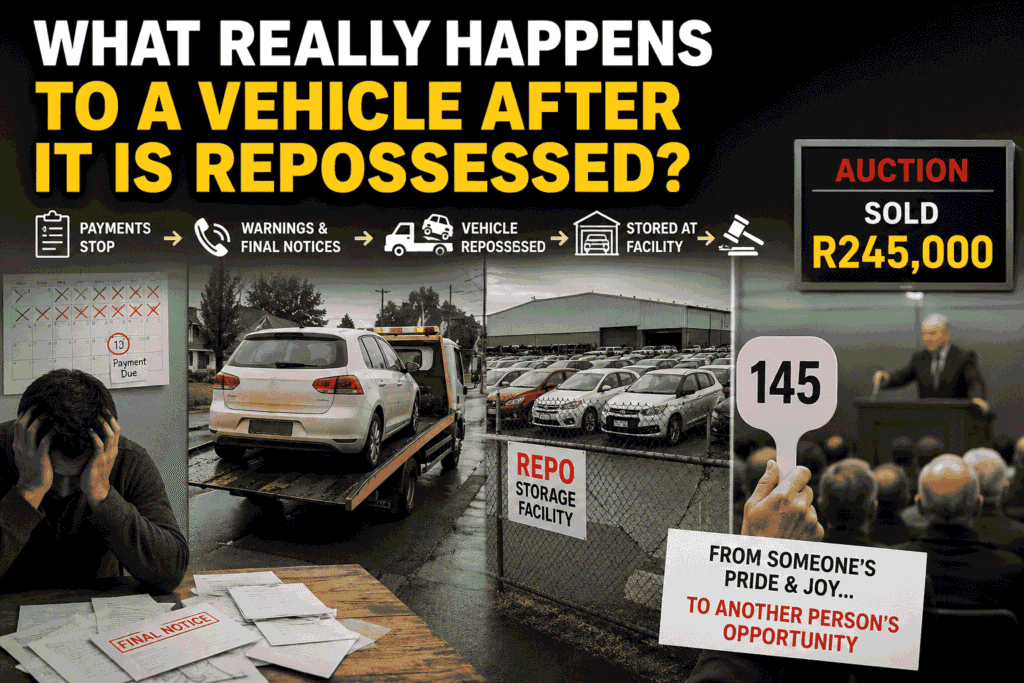
Have you ever stood at a vehicle auction and wondered how a car ended up there?
Maybe you’ve seen a 2020 Mercedes-Benz C200 with a retail value of R400,000 sell for only R245,000. Or perhaps you’ve watched a Toyota Hilux, Audi A3 or Volkswagen Polo go under the hammer and thought:
“What happened to the previous owner?”
The truth is that every repossessed vehicle has a story. Behind every auction car is often a person who once proudly drove that vehicle to work, school runs, family holidays and weekend trips. But somewhere along the way, things changed.
- A job was lost.
- A business struggled.
- Medical bills piled up.
- Debt became overwhelming.
- And eventually the vehicle found its way to auction.
In this article, we’ll follow the journey of a repossessed vehicle from the moment payments stop all the way to the auction floor.
Step 1: The Payments Stop
Imagine a buyer purchases a vehicle worth R400,000. Everything goes well at first.
The monthly instalments are paid on time.
The vehicle is serviced regularly. Life is good. Then something unexpected happens. Perhaps overtime at work disappears. Perhaps a small business starts generating less income. Perhaps interest rates increase and the monthly budget becomes impossible to manage.
One missed payment turns into two.
Then three.
The bank notices.
At this stage, the bank doesn’t want the vehicle back.
In fact, repossessing a vehicle is usually one of the last things a lender wants to do.
The bank would rather help the customer catch up on payments than take possession of the vehicle.
Step 2: Calls, Emails and Final Warnings
Once payments fall behind, collection attempts begin.
The owner may receive:
- Phone calls
- SMS notifications
- Emails
- Letters of demand
Many people assume a bank immediately sends someone to collect the vehicle.
That rarely happens most lenders first try to work with the customer. This stage can last weeks or even months. But if the situation doesn’t improve, the account moves closer to repossession.
Step 3: The Vehicle Is Repossessed
Eventually the vehicle is surrendered or legally repossessed. This is often one of the most emotional moments in the process. For many families, a vehicle isn’t just transport.
- It’s freedom.
- It’s school runs.
- It’s getting to work.
- It’s weekend trips.
- It’s independence.
Once the vehicle is collected, it is transported to a secure storage facility where it waits for the next chapter of its life.
Step 4: Waiting in the Storage Yard
After repossession, the vehicle is inspected and documented.
- The mileage is recorded.
- The condition is assessed.
- The keys are checked.
- Photographs are taken.
At this point, the vehicle becomes an asset that the bank wants to sell as soon as possible. Every day it sits in storage costs money. The longer it remains unsold, the larger the loss becomes.
Step 5: The Auction Listing Appears
This is where buyers like us enter the story.
The vehicle is listed at auction alongside hundreds of others. The previous owner’s journey ends. A new buyer’s journey begins.
Step 6: The Hammer Falls
Auction day arrives. Bidders gather online or in person. The auctioneer begins calling for bids. The price rises. Sometimes bidding becomes competitive. Other times it doesn’t.
One of the most interesting examples from our recent auction data was a 2020 Audi A3.
Estimated Retail Value: R341,000
Auction Price & Fees: R180,000
The winning bidder walked away with a luxury German vehicle for almost half of its estimated retail value.
For the buyer, it may have been a bargain.
For the bank, it represented a significant loss.
Step 7: Why Banks Often Lose Money
This is something many people don’t realise.
Banks don’t repossess vehicles because they want to make money.
They repossess vehicles because they are trying to recover some of the money they have already lost.
Looking at our recent auction data, there are dozens of examples where vehicles sold well below retail value.
Some examples include:
- Mercedes-Benz C200
- Audi A3
- Volkswagen Polo
- Hyundai Tucson
- BMW 1 Series
Once storage costs, administration costs and auction fees are considered, the bank often recovers far less than expected.
What This Means For Auction Buyers
The bank’s loss can sometimes become the buyer’s opportunity.
But that doesn’t mean every auction vehicle is a bargain.
Before bidding, always:
- Inspect the vehicle
- Check service history where possible
- Understand auction fees
- Budget for repairs
- Research market values
The smartest buyers are the ones who do their homework before raising a paddle or placing an online bid.
Conclusion
Every repossessed vehicle has a story.
The Volkswagen Polo, Toyota Hilux, Mercedes-Benz C200 or Audi A3 sitting on an auction floor today once belonged to someone who probably never imagined losing it.
For banks, repossession is usually the final step after every other option has been exhausted. For buyers, it can be an opportunity to purchase a vehicle below market value. Understanding what happens behind the scenes not only makes you a smarter buyer, but also gives you a deeper appreciation for the journey every repossessed vehicle takes before the hammer finally falls.